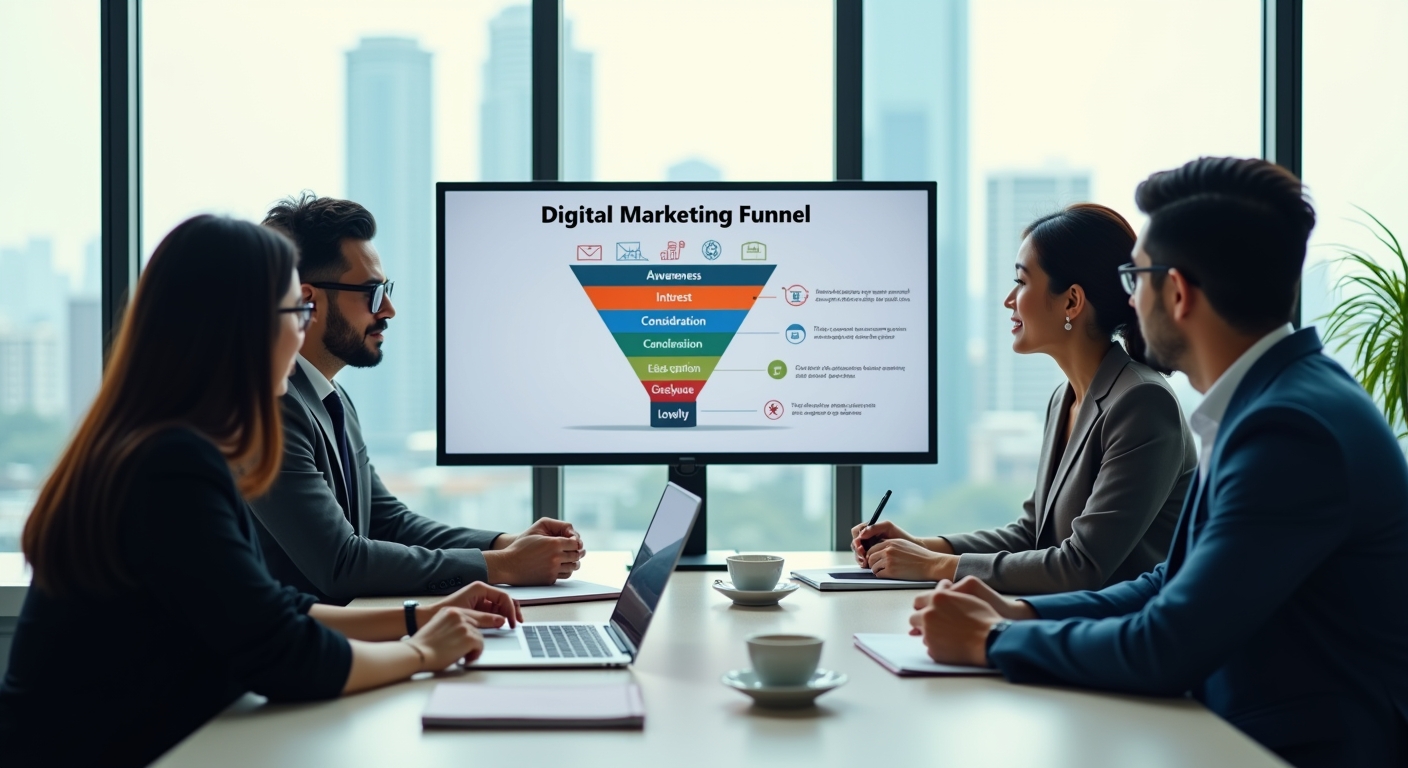
For Malaysian businesses, a digital marketing funnel Malaysia strategy is the process of guiding potential customers from first discovering your brand to becoming paying customers and loyal advocates. It helps you match the right message, channel and offer to each stage, so your marketing becomes more focused, measurable and cost-effective.
Many businesses know they need marketing, but fewer understand why some campaigns attract clicks yet fail to convert. The missing piece is often the funnel. Instead of treating every prospect the same, a funnel helps you move people step by step: from awareness, to interest, to consideration, to action, and finally to retention.
If you are new to digital marketing Malaysia, understanding the funnel gives you a practical framework for planning content, ads, social media and follow-up activities. Whether you run a local café in Shah Alam, a clinic in Johor Bahru, an e-commerce store in Kuala Lumpur or a B2B service firm in Penang, the same funnel logic applies.
Definition: A digital marketing funnel is a structured customer journey that shows how people move from discovering a business online to taking a desired action, such as making an enquiry, booking an appointment or completing a purchase.
Quick answer: what is a digital marketing funnel?
A digital marketing funnel is a model that helps Malaysian businesses attract the right audience, build trust, generate leads or sales, and retain customers through targeted marketing at each stage. Rather than relying on one-off campaigns, it creates a repeatable system for growth.
Why does a digital marketing funnel matter for Malaysian businesses?
Malaysian buyers are not all at the same stage when they find your business. Some are only browsing on social media. Others compare prices on marketplaces, read reviews, or search Google before contacting you. A funnel helps you respond to this behaviour more effectively.
Without a funnel, businesses often make three common mistakes:
- They push for sales too early
- They create content without a clear goal
- They spend on ads but do not nurture leads afterwards
With a funnel, you can:
- Choose the right channels for each stage
- Create content that matches customer intent
- Measure where leads drop off
- Improve return on ad spend and marketing efficiency
- Build stronger long-term customer relationships
This is especially useful for SMEs with limited budgets. If you want a broader view of channels before building your funnel, read Types of Digital Marketing Explained for Malaysian Businesses.
What are the main stages of a digital marketing funnel?
Most funnels can be broken into five clear stages. Different marketers may use slightly different labels, but the idea remains the same.
1. Awareness
This is the top of the funnel, where people first discover your business. They may find you through Google search, Facebook, Instagram, TikTok, YouTube, online articles, local directories or word of mouth that leads them online.
At this stage, the prospect may not know your brand yet. They may not even realise they need your product. Your job is to earn attention and introduce relevance.
Examples of awareness content:
- Educational blog posts
- Short-form social media videos
- Search-optimised service pages
- Display ads and social ads
- Infographics and beginner guides
2. Interest
Once people know you exist, they start exploring. They may visit your website, follow your social pages, read your posts or watch your videos. Here, your content should help them understand the problem and possible solutions.
A Malaysian skincare brand, for example, might publish content on choosing products for humid weather. A B2B software provider might explain how automation reduces admin work.
3. Consideration
At this stage, prospects compare options. They may look at features, pricing, testimonials, FAQs, delivery details or your track record. They want reassurance that your business is credible and suitable.
This is where trust matters most. Useful content includes:
- Comparison pages
- Case examples
- Testimonials and reviews
- Detailed service pages
- Webinars, demos or consultations
If your audience is deciding between channels or approaches, a useful companion read is Online Marketing vs Traditional Marketing in Malaysia.
4. Conversion
Conversion is the point where a prospect takes your desired action. Depending on your business model, that could be:
- Buying a product
- Filling in a lead form
- Sending a WhatsApp enquiry
- Booking a consultation
- Registering for a class or event
Your goal is to reduce friction. Clear pricing, fast-loading pages, simple forms, strong product information and easy contact options all help.
5. Retention and advocacy
The funnel does not end after the first sale. Existing customers are often easier and cheaper to retain than winning completely new ones. Follow-up emails, loyalty rewards, good customer service and useful after-sales content can encourage repeat purchases and referrals.
For many Malaysian SMEs, retention is one of the most underused growth levers.
How does the digital marketing funnel work in practice?
The best way to understand the funnel is to see how one prospect moves through it.
Example: local dental clinic in Kuala Lumpur
Awareness: A user searches for tips on braces care or teeth whitening and finds the clinic’s article on Google.
Interest: They browse the clinic’s Instagram page, read more articles and learn about treatment options.
Consideration: They compare the clinic with others, check location, pricing guidance, dentist credentials and reviews.
Conversion: They book an appointment through WhatsApp or an online form.
Retention: The clinic sends appointment reminders, aftercare advice and check-up prompts.
This simple flow shows why every stage needs different messaging. A person who has never heard of your clinic does not need a hard sales pitch first. They need useful information and confidence.
Which channels fit each stage of the funnel?
| Funnel Stage | Customer Mindset | Best-Fit Channels | Typical Goal |
|---|---|---|---|
| Awareness | I am exploring or learning | SEO, blog content, social media, video content, display ads | Reach and visibility |
| Interest | I want to know more | Website content, email sign-ups, lead magnets, educational videos | Engagement |
| Consideration | I am comparing options | Service pages, testimonials, FAQs, remarketing ads, consultations | Trust and lead qualification |
| Conversion | I am ready to act | Landing pages, WhatsApp, e-commerce checkout, lead forms | Sales or enquiries |
| Retention | I may buy again | Email marketing, CRM follow-up, loyalty offers, customer support | Repeat business and referrals |
Not every business needs every channel. What matters is choosing channels that match customer behaviour and your internal capacity.
How can Malaysian businesses build a digital marketing funnel step by step?
Step 1: define your audience clearly
Start with who you want to reach. Be specific. General targeting produces weak messaging.
Ask:
- Who is the buyer?
- What problem are they trying to solve?
- What triggers them to search?
- What concerns stop them from buying?
- Which platforms do they actually use?
For example, a B2B accounting firm targeting SME owners in Selangor will need a different funnel from a fashion brand targeting Gen Z shoppers nationwide.
Step 2: map the customer journey
Write out the likely path from first touch to sale. Include search behaviour, content touchpoints, questions and barriers.
A simple journey map may look like this:
- Searches a question on Google
- Reads a guide
- Visits service page
- Checks social proof
- Enquires via form or WhatsApp
- Receives follow-up
- Converts
Step 3: create content for each stage
One of the biggest funnel mistakes is publishing only bottom-funnel content. If you only post sales offers, you miss the chance to attract and educate earlier-stage prospects.
Build a balanced content mix:
- Top of funnel: guides, explainers, beginner questions, trend articles
- Middle of funnel: case-based insights, service explanations, comparisons, email nurturing
- Bottom of funnel: pricing, consultation pages, demos, product pages, testimonials
If you run a smaller company, this is especially relevant. For more practical small-business context, see Digital Marketing for SMEs Malaysia: Practical Growth Guide.
Step 4: choose measurable goals
Each stage should have a realistic metric. Awareness content should not be judged by direct sales alone.
Useful examples include:
- Awareness: impressions, reach, organic traffic
- Interest: time on page, email sign-ups, social engagement
- Consideration: enquiry page visits, lead quality, remarketing clicks
- Conversion: purchases, form completions, booked calls
- Retention: repeat purchase rate, renewal rate, customer referrals
Step 5: set up follow-up and nurturing
Many leads do not convert immediately. That does not mean they are poor leads. They may simply need more time or information.
Nurturing methods can include:
- Email sequences
- Remarketing ads
- WhatsApp follow-ups
- Educational newsletters
- Promotions for returning customers
Step 6: review and improve regularly
A funnel is not a one-time diagram. It should evolve based on performance. If traffic is strong but enquiries are weak, the issue may be your offer, landing page or call-to-action. If enquiries are high but sales are poor, lead quality or sales handling may need improvement.
What does a good digital marketing funnel look like for different business types?
E-commerce brand
- Awareness: TikTok videos, influencer seeding, SEO category content
- Interest: product education, live sessions, email discount sign-up
- Consideration: reviews, shipping information, FAQs
- Conversion: checkout optimisation, abandoned cart reminders
- Retention: loyalty offers, restock alerts, post-purchase email flows
Professional services firm
- Awareness: blog articles, LinkedIn content, search visibility
- Interest: downloadable guides, email capture, service explainers
- Consideration: credentials, results, consultation pages, testimonials
- Conversion: strategy call or discovery meeting
- Retention: ongoing advisory updates and client nurturing
Local service business
- Awareness: Google Business Profile, local SEO, social posts
- Interest: before-and-after content, pricing guidance, service FAQ
- Consideration: customer reviews, response speed, location details
- Conversion: booking form, WhatsApp, call button
- Retention: rebooking reminders and referral incentives
What are the most common funnel mistakes?
Even businesses with active marketing can struggle if the funnel is incomplete or misaligned.
Expecting immediate sales from cold traffic
New audiences usually need education and trust-building first, especially for higher-value services.
Ignoring middle-funnel content
Many brands create awareness posts and sales pages but skip the content that helps buyers compare confidently.
Sending traffic to weak landing pages
If the page is slow, unclear or cluttered, your ad budget and SEO traffic are wasted.
Not tracking what happens after the click
Traffic alone does not prove success. You need visibility on enquiries, lead quality and conversion.
Forgetting retention
A funnel focused only on acquisition can become expensive. Repeat buyers often improve profitability.
How do you know if your funnel is working?
A healthy funnel does not mean every person converts. It means each stage performs its job and supports the next one.
Signs your funnel is working include:
- Steady growth in relevant traffic
- Good engagement on educational content
- More qualified leads, not just more leads
- Consistent conversion paths from content to enquiry or sale
- Repeat business from existing customers
If you are still shaping your overall strategy, it also helps to understand How Businesses Use Digital Marketing in Malaysia so you can see where the funnel fits into a wider marketing mix.
Key takeaways
- A digital marketing funnel helps Malaysian businesses guide prospects from discovery to conversion and retention.
- The main stages are awareness, interest, consideration, conversion and retention.
- Different funnel stages need different content, channels and messaging.
- Businesses often underperform when they push sales too early or ignore follow-up.
- A practical funnel improves clarity, budget efficiency and long-term growth.
- Even simple funnels are effective when they are aligned with real customer behaviour.
Frequently asked questions
What is the difference between a sales funnel and a digital marketing funnel?
A sales funnel usually focuses on turning leads into customers, while a digital marketing funnel covers the broader online journey, including awareness, education, engagement and retention. In practice, the two often overlap.
Does every Malaysian SME need a digital marketing funnel?
Yes, although it does not need to be complex. Even a small business benefits from knowing how customers discover the brand, what information they need before buying, and how to follow up after the first interaction.
Which platform is best for the top of the funnel?
There is no single best platform for every business. SEO, social media and video content are common top-of-funnel channels, but the right choice depends on your audience, industry and resources.
How long does it take to see results from a funnel?
That depends on your channel mix and sales cycle. Paid campaigns may generate data quickly, while SEO and content marketing often take longer. What matters is building a system that supports sustainable growth rather than chasing isolated short-term wins.
Can one piece of content serve multiple funnel stages?
Yes. A well-written guide can attract awareness traffic, build trust during consideration and lead users towards conversion through strong internal links and clear next steps. However, your overall content strategy should still cover all stages intentionally.
Conclusion
The digital marketing funnel is one of the most useful frameworks for making sense of online marketing. Instead of treating digital activity as disconnected posts, ads and pages, it helps Malaysian businesses create a clearer path from visibility to trust, from trust to action, and from action to loyalty. When you understand what your audience needs at each stage, your marketing becomes more relevant and more effective.
If you want to deepen your understanding of the bigger picture, continue with our guide to Types of Digital Marketing Explained for Malaysian Businesses to see which channels can support each stage of your funnel more effectively.