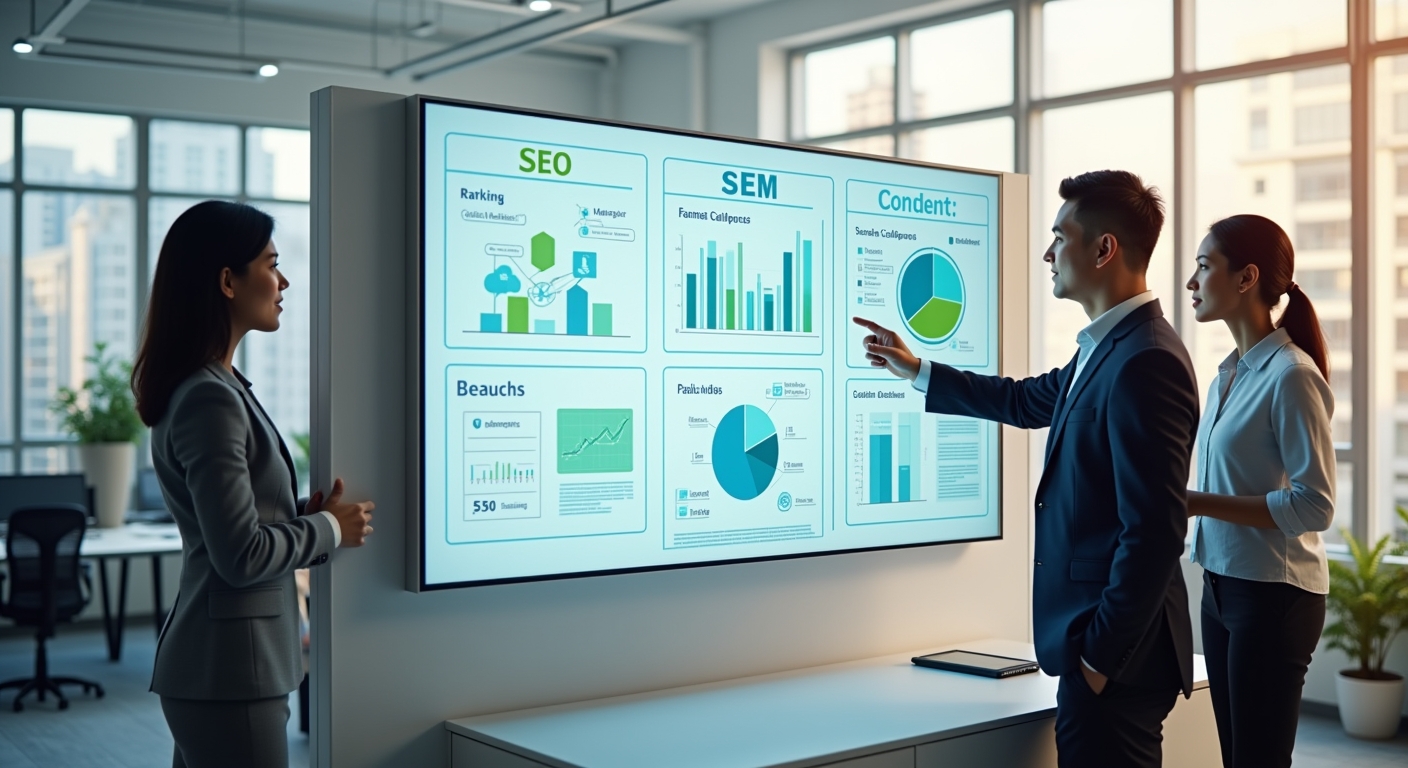
Choosing the right digital marketing channels Malaysia businesses should invest in depends on your goals, budget, timeline and customer journey. SEO builds long-term visibility, SEM delivers immediate traffic, social media grows reach and engagement, and content marketing supports trust and conversion. The best option is often a balanced mix rather than a single channel.
For many Malaysian businesses, the challenge is not whether digital marketing works, but which channel deserves priority first. A B2B services firm in Kuala Lumpur may benefit most from SEO and content, while a retail brand launching a promotion may need SEM and social ads for faster results. Understanding the strengths, costs and trade-offs of each channel helps you allocate budget more confidently.
In this guide, we compare SEO, SEM, social media and content marketing from a practical business perspective so you can decide what suits your growth stage, industry and objectives.
Digital marketing channels are the platforms and methods businesses use online to reach, attract and convert customers, including search engines, paid ads, social media, websites, email and content. In practice, each channel plays a different role across awareness, consideration and conversion.
Quick answer: which digital marketing channel is best?
There is no single best channel for every business. SEO is strong for long-term organic growth, SEM is ideal for immediate lead generation, social media works well for brand visibility and audience interaction, while content marketing strengthens authority and supports both SEO and sales. The right choice depends on your business model, target audience and timescale.
How do the main digital marketing channels compare?
| Channel | Best for | Time to see results | Cost pattern | Main strength | Main limitation |
|---|---|---|---|---|---|
| SEO | Long-term traffic and enquiries | Medium to long term | Ongoing investment | Sustainable visibility | Takes time to build |
| SEM | Fast traffic, leads and sales | Immediate to short term | Pay-per-click or campaign based | Speed and targeting | Traffic stops when spend stops |
| Social Media | Awareness, engagement and community | Short to medium term | Flexible organic and paid spend | Audience interaction | Lower intent than search |
| Content Marketing | Trust, education and conversion support | Medium to long term | Upfront creation plus ongoing updates | Builds authority across channels | Needs consistency |
What should Malaysian businesses consider before choosing a channel?
Before comparing performance, start with the business context. A channel that works well for one company may be inefficient for another.
Business goals
If your goal is immediate enquiries, SEM may deserve early budget. If you want to reduce reliance on paid traffic over time, SEO and content usually become more important. If brand visibility matters, social media can play a larger role.
Sales cycle
Short buying cycles often suit paid search and social campaigns. Longer decision cycles, such as professional services, education or high-value B2B sales, often benefit from SEO and content that answers questions throughout the buying journey.
Audience behaviour
Ask where your customers actively search, compare and engage. For example:
- People looking for a service now often turn to Google.
- Consumers discovering products may spend more time on Instagram, Facebook or TikTok.
- B2B decision-makers may respond better to educational content, search visibility and LinkedIn-led campaigns.
Budget and internal capacity
Some channels need more consistent content production. Others need tighter campaign management and optimisation. If you have a lean team, channel choice should reflect available expertise as well as media budget.
If you want broader context first, see digital marketing Malaysia for a full overview of how different tactics fit together.
Is SEO the right channel for long-term growth?
SEO is usually the strongest long-term channel for businesses that want qualified traffic from people actively searching for solutions. It focuses on ranking in search engines for relevant queries, making your site more visible when intent is high.
When SEO works best
- Your customers search Google before making a decision.
- You want ongoing leads without paying for every click.
- Your business offers services across specific cities or regions in Malaysia.
- You are willing to invest consistently over several months.
Key advantages of SEO
- Builds sustainable visibility over time.
- Attracts high-intent traffic.
- Supports local search, especially for service-based businesses.
- Improves website quality, content depth and user experience.
Main limitations of SEO
- It rarely delivers instant results.
- Competitive sectors need stronger content and technical work.
- Results depend on ongoing optimisation, not one-off setup.
For example, a law firm in Petaling Jaya or an accounting company in Johor Bahru may gain more value from ranking for service-related searches than from purely awareness-driven social posting.
Best fit for SEO
SEO is often the best choice for professional services, healthcare, education, home services, B2B companies and local businesses that depend on search demand.
When is SEM a better choice than SEO?
SEM, usually through Google Ads, is best when you need visibility quickly. Unlike SEO, which builds gradually, SEM places your business in front of searchers almost immediately, provided campaigns are well targeted.
When SEM works best
- You need leads or sales quickly.
- You are launching a product, offer or seasonal campaign.
- You want to test keywords before investing heavily in SEO.
- You operate in a competitive market where organic rankings take longer.
Key advantages of SEM
- Fast traffic and measurable campaign performance.
- Clear control over targeting, budget and search intent.
- Useful for landing page testing and offer validation.
- Can target location-specific demand in Malaysia.
Main limitations of SEM
- Clicks can be expensive in competitive sectors.
- Performance depends on campaign setup and optimisation.
- Traffic stops when the budget stops.
SEM suits businesses that need speed. For example, a tuition centre promoting new intakes or an ecommerce store running a festive campaign may use paid search to capture demand right away.
Best fit for SEM
SEM is often effective for lead generation campaigns, limited-time offers, ecommerce promotions, urgent service demand and businesses entering a new market.
How effective is social media for business growth?
Social media is valuable, but its role is often misunderstood. It is excellent for awareness, engagement and audience nurturing, yet not always the strongest direct-response channel unless supported by paid campaigns, strong creative and the right audience fit.
When social media works best
- Your audience spends significant time on social platforms.
- Your product or service is visual, lifestyle-led or community-driven.
- You want to increase brand recognition and repeat touchpoints.
- You have content that encourages interaction.
Key advantages of social media
- Builds familiarity and trust through regular visibility.
- Supports both organic content and paid promotion.
- Useful for retargeting audiences who already know your brand.
- Can humanise your business and show social proof.
Main limitations of social media
- Organic reach can be inconsistent.
- Users may not have immediate purchase intent.
- Results depend heavily on creative quality and consistency.
In Malaysia, social media can be especially useful for food and beverage, fashion, beauty, events, lifestyle brands and creator-led businesses. For service providers, social often works best as a trust-building support channel rather than the main lead source.
Best fit for social media
Social media is a strong option for consumer brands, community building, promotions, remarketing and visual storytelling. It is usually more effective when integrated with content and paid strategy.
Why does content marketing matter across every channel?
Content marketing is less a standalone traffic source and more the foundation that makes other channels perform better. Articles, landing pages, case-led insights, videos and guides help customers understand your offer and move closer to enquiry or purchase.
When content marketing works best
- Your customers need education before they buy.
- You want to build expertise and trust in a competitive market.
- You are supporting SEO, email, social and sales enablement together.
- You want assets that can be reused across multiple campaigns.
Key advantages of content marketing
- Supports SEO rankings through relevant topic coverage.
- Helps sales conversations by answering common objections.
- Improves conversion by building trust before contact.
- Can be repurposed into social posts, ads, guides and email content.
Main limitations of content marketing
- Requires planning, quality control and consistency.
- Results compound over time rather than instantly.
- Weak or generic content rarely performs well.
For many businesses, content is what links channels together. A useful guide can attract SEO traffic, be promoted on social media, support an ad campaign and help a sales team answer buyer questions better.
For a wider overview of channel categories, read Types of Digital Marketing Explained for Malaysian Businesses.
Which channel is best for each business objective?
| Business objective | Most suitable channel | Why |
|---|---|---|
| Generate leads quickly | SEM | Captures active search demand fast |
| Build long-term organic traffic | SEO | Creates sustainable search visibility |
| Increase brand awareness | Social Media | Expands reach and repeat exposure |
| Build trust and educate buyers | Content Marketing | Answers questions and supports decisions |
| Reduce reliance on paid ads over time | SEO + Content | Builds owned visibility and authority |
| Launch a campaign or promotion | SEM + Social | Combines speed, targeting and visibility |
Should you choose one channel or combine several?
In most cases, the best approach is not choosing only one channel. It is choosing the right lead channel and supporting channels.
A practical way to combine them
- SEO + Content: ideal for long-term lead generation and trust-building.
- SEM + Landing Pages: ideal for fast testing, promotions and lead capture.
- Social + Content: ideal for awareness, engagement and nurturing.
- SEO + SEM: ideal when you want quick wins now while organic visibility grows.
For example, an SME may start with SEM to generate early enquiries, build SEO-ready service pages in parallel and use social media to stay visible to prospects who have visited the website but are not ready to act yet.
This is especially relevant for growing companies. If that sounds familiar, Digital Marketing for SMEs Malaysia: Practical Growth Guide offers a more detailed view of what to prioritise with limited resources.
How can you decide which channel to prioritise first?
Use this simple selection framework.
- Define the goal. Do you need leads now, stronger visibility later, or both?
- Review buyer intent. Are customers actively searching, browsing socially or comparing options over time?
- Assess your budget. Can you support paid media, ongoing SEO work or content production consistently?
- Check your website readiness. Even strong channels underperform if your site is slow, unclear or weak at conversion.
- Choose a primary channel. Start with the one most aligned to your goal.
- Add a support channel. Use another channel to strengthen the main one.
- Measure commercial outcomes. Track leads, cost per enquiry, conversion quality and revenue impact, not just clicks.
What mistakes do businesses make when comparing channels?
- Expecting SEO to work as quickly as paid ads.
- Relying only on social media without a clear conversion path.
- Running SEM without strong landing pages or tracking.
- Publishing content without a strategy linked to business goals.
- Comparing channels only by traffic rather than lead quality and return.
- Switching channels too quickly before enough data is gathered.
A better comparison considers your market, customer intent, conversion process and time horizon. Channels are not equal because they do different jobs.
Key takeaways
- SEO is best for sustainable long-term visibility and high-intent traffic.
- SEM is best for immediate traffic, testing and lead generation.
- Social media is best for awareness, engagement and remarketing support.
- Content marketing builds trust and improves the performance of other channels.
- Most Malaysian businesses benefit from a combination rather than a single platform.
- The right choice depends on business goals, budget, audience behaviour and buying cycle.
Frequently asked questions
Which digital marketing channel gives the fastest results?
SEM usually delivers the fastest results because paid search can place your business in front of active searchers almost immediately. However, speed alone does not guarantee profitability. Campaign quality, landing pages and targeting still matter.
Is SEO better than social media for Malaysian businesses?
It depends on the business model. SEO is often better for service-based businesses and companies targeting search intent, while social media is stronger for awareness, visual products and audience engagement. Many businesses need both, but for different reasons.
Can small businesses afford to use more than one channel?
Yes, but they should prioritise carefully. A small business may start with one lead channel and one support channel, such as SEM plus remarketing, or SEO plus content. The goal is not to be everywhere, but to invest where returns are most likely.
What is the best channel for B2B marketing in Malaysia?
B2B businesses often perform well with SEO, content marketing and selective SEM because buyers usually research carefully before making contact. Social media can still help, especially for credibility and retargeting, but it is not always the main conversion driver.
How long should you test a channel before deciding?
That depends on the channel. SEM can produce useful data relatively quickly, while SEO and content usually need a longer commitment. The important point is to measure meaningful outcomes such as qualified enquiries and conversion rates rather than making decisions from impressions alone.
Conclusion
Comparing digital marketing channels is not about finding a universal winner. It is about choosing the channel mix that matches your business priorities. If you need fast demand capture, SEM is often the most practical starting point. If you want durable visibility and lower reliance on paid traffic over time, SEO and content deserve serious investment. If your audience responds to brand presence and regular engagement, social media can add valuable reach and trust. The strongest strategy is usually the one that aligns channel roles with the way your customers actually discover, evaluate and choose.
If you are weighing up which channels deserve budget next, continue by comparing your options against your goals, team capacity and sales cycle, then use that shortlist to build a more focused plan for the next quarter.